Showing posts with label bass guitar discussion. Show all posts

Wednesday, March 18, 2015

The Right Bass for You


The Right Bass for You

Deciding to pick up the bass usually follows some sort of inspiration—be it from school, popular music, a friend, or family member. And getting to the point where the instrument is actually in your hands is often preceded by lots of letters to Santa, mowing acres of grass, or just begging and pleading your case to mom and dad. At age 13, my folks let me buy my first bass for the handsome sum of $110, deeply denting the savings I had amassed from birthday gifts and the aforementioned yard work.

Wednesday, January 21, 2015

Passive vs. Active Circuitry?


Q: I’m just getting back into the bass and there’s something I’ve always been curious about: the differences (as well as the different kinds) of passive vs. active circuitry. What are the main differences between them, why are there only active and passive circuits, and what does it mean to have either in a bass?

Monday, March 10, 2014

Buying a Bass Guitar Via the Internet

Buying a Bass Guitar  via the Internet


There can be many reasons for wanting to buy a bass via the Internet. Maybe you live in a place with no music stores? Maybe the only music store in your area only carries Fender? Maybe you came across a great deal on ebay? Whatever the reason is, buying on the Internet is not always as straight foreward as it might seem.

Sunday, March 9, 2014

Developing Timing and Feel: Rhythmic Studies for Bass Players

Developing Timing and Feel: Rhythmic Studies for Bass Players

Q: My question is about timing. I realize that the choice of notes make a line hip, but the rhythm and the timing make the groove! How do you practice timing, Damian?

Thursday, January 16, 2014

Why Bassists Make Great Musical Directors

Why Bassists Make Great Musical Directors


As someone who left his native country to pursue music in the U.S., and who spends most of his life on the road, my definition of “home” is an interesting one. For me, home boils down to an environment where I’m most at ease in my own skin. For me, that’s the stage, with the drummer to my right, my amp behind me, and the singer and familiar view of the crowd in front of me.

Friday, January 3, 2014

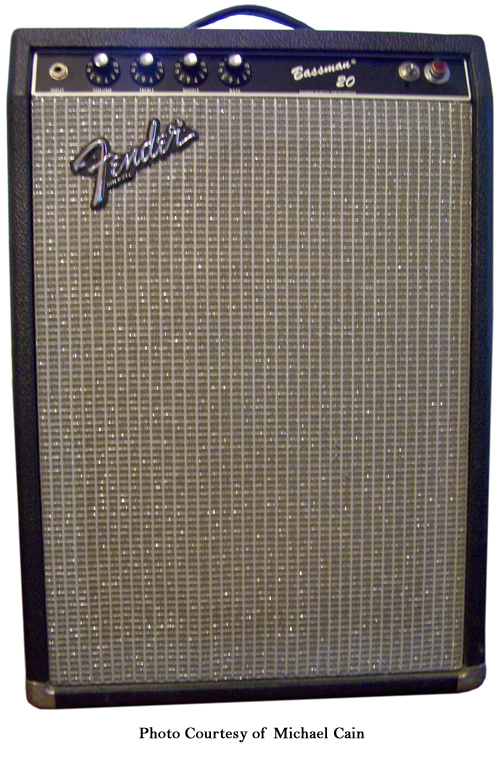
Trash or Treasure: Fender Bassman 20

Trash or Treasure: Fender Bassman 20

Q:I have a Fender Bassman 20 that I mainly use for playing guitar. I read in a couple of places that fewer than 600 of them were made. Do you know the reason for that? I also read that the Bassman 20 is better suited for guitar than bass. Trash or Treasure?
Thanks,
James B. in Columbus, North Carolina

Thursday, January 2, 2014

The Rock Bass Tone that Won’t Go Away


The Rock Bass Tone that Won’t Go Away

If you are a guitarist or bassist who is old enough to have lived through a few stylistic trends in rock, you know that each one comes with its own tone or amp trend as well. For the guitarist, the signs are pretty obvious. A few years back, for example, it was nearly impossible to hear a heavy rock album without a Mesa/Boogie Rectifier melting your face.
But when it comes to bass, there is a singular tone that has survived through most of rock ’n’ roll’s trends and can be heard in most genres of rock—be it the British new wave and punk bands of the ’70s, the hair-metal bands of the ’80s, or the modern rock and punk bands of the ’90s and today.

Getting The Best Out of Your Bass Tracks

Getting The Best Out of Your Bass Tracks

As bassists, the fate of where our beloved lines land in the mix depends on a number of things. Over the years, I’ve been able to eliminate most of the concerns I used to carry around with me—concerns I’d have from the second the session ended until I heard the final record weeks or months later. I hope these tips can help you avoid those periods of anxiety and be useful to you on your quest for studio bliss.

Friday, December 27, 2013

The Space of the Bass


The Space of the Bass


What is the sound you hear in your head when you think of the word “bass”? For some, it means a huge tone containing the entire frequency range and all the overtones and vibrancy of a grand piano’s low strings. To others, it just means massive low end—like the enormous, pillowy sound that Aston “Family Man” Barrett got with Bob Marley & the Wailers. There are also players who consider bass to be the punchy sound in the low-mid register—that tone many of us affectionately refer to as “the Jaco sound.”

Mastering the Groove


Talking about “groove” and what it means is almost like talking about politics or religion: It sparks wildly different and passionate opinions. Groove is a word that gets thrown around a lot, and in my opinion, is often misused. I squirm when I hear a producer ask a drummer for a different groove, when he should actually be asking for a different beat or a different pattern. The groove, to me, is the space that happens between the beats. The groove is the rhythmical relationship of notes played by several musicians together, and yet it’s still nearly impossible to put your finger on its essence. 

Thursday, December 26, 2013

Learning New Tunes: Go Beyond the Bass

Learning New Tunes: Go Beyond the Bass


Let’s face it, we’re not all singers. Some of us opted to join band in school instead of choir, and in doing so, we missed out on the vocal warm-ups and breathing lessons. We never took the bull by the horns and sang lead, be it on stage or around a campfire, and maybe a few of us have been labeled moderately tone deaf when it comes to harmonizing.

Saturday, December 21, 2013

Adjusting to the Upper Register on a 6-String Bass

Adjusting to the Upper Register on a 6-String Bass

Q: I have an issue with playing my 6-string bass so I searched the No Treble archives and found that you once wrote tips for making the shift from 4- to 6-string bass. I followed your advice there, but when playing a two octave scale past 12th fret (lets say F-Ionian), beginning on the B string, its hard (for me at the moment at least) not to have a crooked wrist/hand position. If I straighten out my wrist, I cant keep a “correct” hand position.

Friday, December 20, 2013

Choosing a Bass: Price, Age, Quality, and Other Questions

Choosing a Bass: Price, Age, Quality  and Other Questions

Q: I’d like to know the difference between a quality bass and a mediocre one. I have a 1977 Fender Precision bass I absolutely love (I paid $450.00 for it in 1976. Until this year, I thought it was a ’76 P bass, but according to the serial number it’s a ’77).

Thursday, December 19, 2013

Do I Really Need to Go To Music School?

Do I Really Need to Go To Music School?

Q:I’m a bass player from Mexico and I am currently studying in Paris and looking for some gigs. I am a little overwhelmed right now by school, which is a jazz-oriented school. I like jazz, but I feel a little forced to learn licks and that stuff. I’m not saying I’m the greatest bass player or anything, but I don’t feel very motivated to study those pieces over and over like I used to do.

Choosing A Bass: A How To Guide

Choosing A Bass: A How To Guide


Q: I’m thinking of buying a new bass. What do you look for when instrument shopping?
A: There’s so much that can go into the consideration of a new instrument. The obvious things are: Cost, Function (is this your “do it all” bass, or for recording, or a good slap bass?)

Wednesday, December 18, 2013

Bass Strings: To Change Or Not To Change

Bass Strings: To Change Or Not To Change
For years, bass players have debated the concept of changing strings and most people have asked the same questions: Doesn’t it change the sound of the instrument? Does the funk disappear? How can someone get good tone playing strings that are a year old? Don’t you know that (insert famous bass player) never changed his strings? Don’t you know that (insert other famous bass player) changes his strings every few shows?

How To: Adjusting Bass Pickups

How To: Adjusting Bass Pickups

Because everyone plays differently and every bass is different – even when comparing two similar models from the same company – there is no black and white rule pertaining to setting your pickup height. That said, this column will walk you through the general principles and techniques of setting up your pickups, and considerations you should make when doing so.

Cabinet Size: Is Bigger Better?

Cabinet Size: Is Bigger Better?

Q: I have a question regarding the cabinet sizes. I see a lot of players lugging around some real beasts. I tend to use my DI for most medium to larger gigs and sometimes just go through the PA. I can’t see a need for a monster rig and wonder why so many bassist are breaking their backs lugging around 810 monster cabs. What’s your take?

To Effect or Not to Effect? A Discussion for Bassists

To Effect or Not to Effect? A Discussion for Bassists
Q: What’s your take on effects pedals? Do you use any?
A: I have been exploring many different pedals and having fun with the sonic possibilities, though I rarely use them outside of my home. My most used pedal is my reverb

Tuesday, December 17, 2013

Life as a Working Bassist: Where Does the Money Come From?

Life as a Working Bassist: Where Does the Money Come From?
Q: What is the reality of how guys like you earn a living? I don’t mean to imply that you are “rolling in it,” but how do bassists who focus on freelance work actually make ends meet?
A: Great question! Although I’ve talked about the various ways to make things happen in a career or in a scene, I don’t think I’ve ever really covered the financial side of it.